

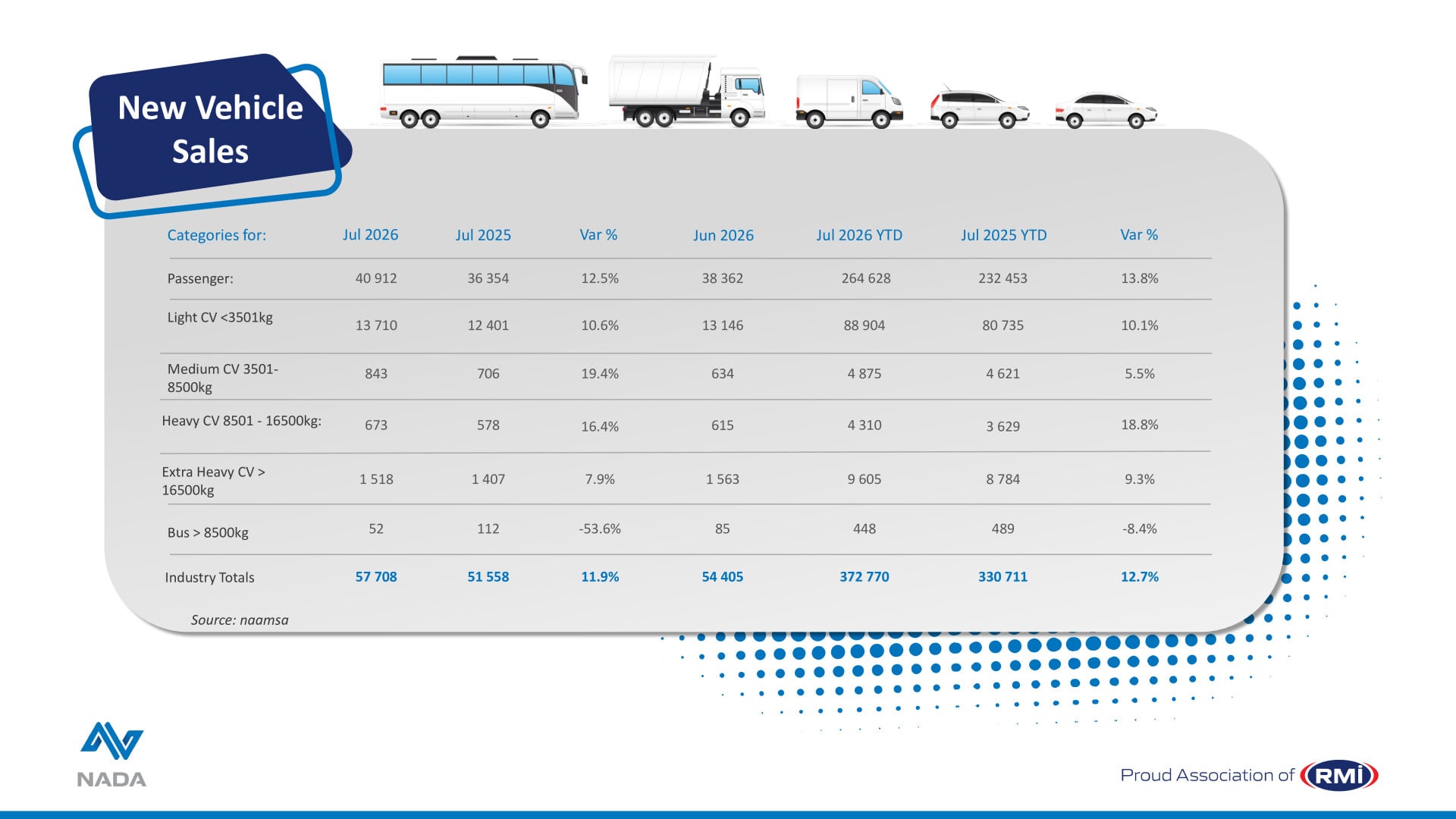
South Africa's automotive sector recorded its strongest monthly performance in years during July 2026, with new vehicle sales jumping nearly 12% compared to the same period last year, buoyed by significant fuel price reductions that provided relief to cash-strapped consumers.Total domestic new vehicle sales reached 57,708 units in July, an increase of 6 150 units from the 51 558 vehicles sold in July 2025, according to data released by the Automotive Business Council.
The passenger car segment delivered the most striking performance, with 40 912 units sold – the best monthly figure since September 2014. This represented a 12,5% increase from the 36 354 new cars sold in July last year.
Light commercial vehicles, including bakkies and mini-buses, also recorded solid growth with 13 710 units sold, up 10,6% from 12 401 units in July 2025.The medium commercial vehicle segment saw 843 units change hands, marking its strongest month since March 2023, while heavy trucks and buses reached 2 243 units, a 7% improvement year-on-year.
Starting or running a small business and in need of a bakkie – click here
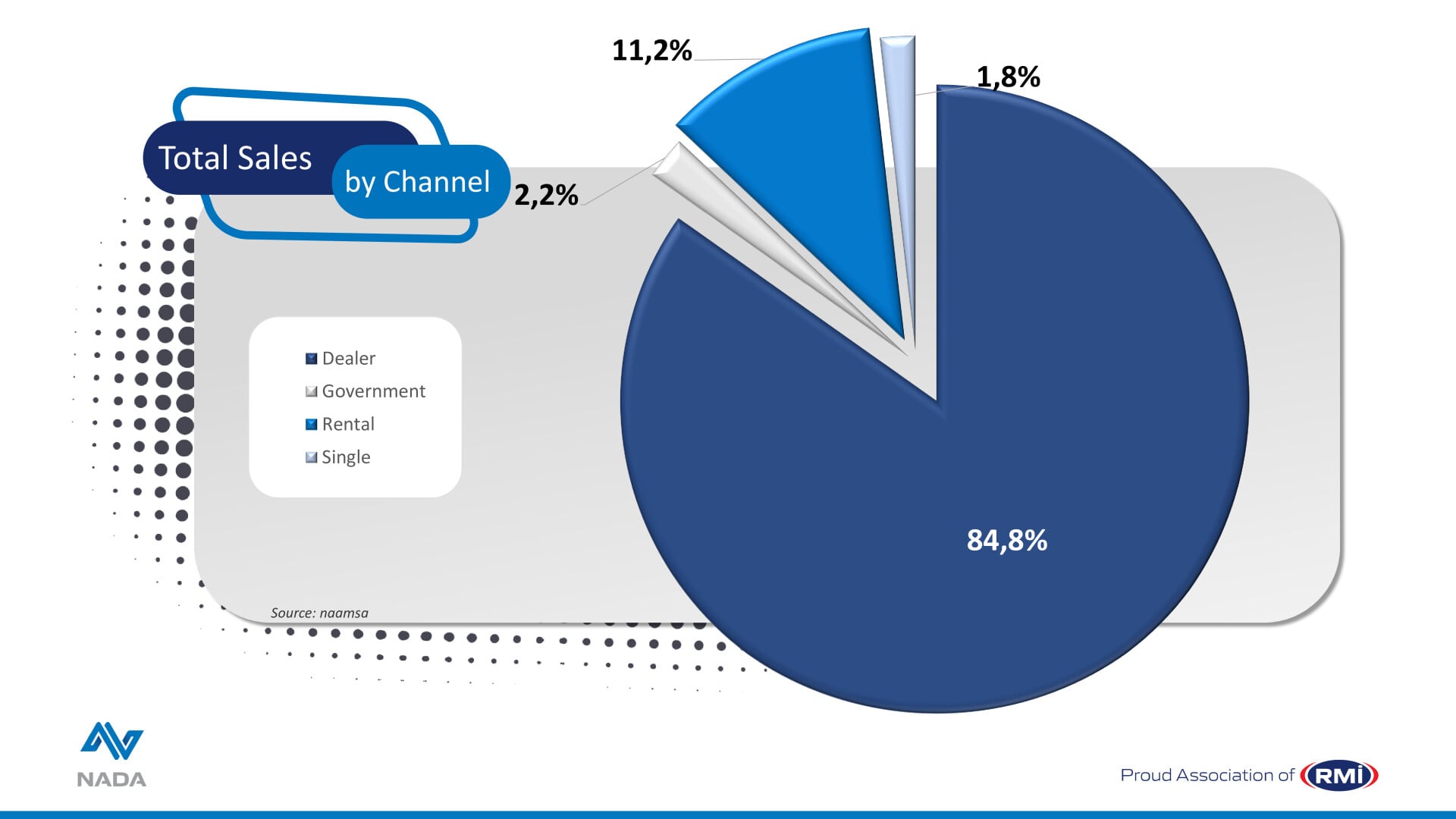
"The July results clearly indicate that consumer confidence is improving," says Brandon Cohen, Chairperson of NADA. "With 84,8% of all new vehicles sold during July being retailed through dealerships, these figures are an outstanding endorsement of the resilience of South African consumers and the strength of the retail motor industry. Consumers are once again prepared to invest in their mobility when the right value, affordability and finance solutions come together, and dealerships across the country are seeing that confidence translate into showroom activity."
The July fuel price adjustments saw the petrol price drop by R1,05 per litre and diesel by between 98 cents and R1,01 per litre, providing tangible relief for motorists and businesses – sadly not so much for the August outlook.
This came despite the full reinstatement of the General Fuel Levy, which had been partially suspended in previous months. The levy now stands at R4,02 per litre for petrol and R4,02 for diesel.
Industry observers noted that the lower fuel costs helped offset persistent affordability pressures, with household budgets stretching further as operating costs declined.
You are just one click away from finding the very best finance deal for your new car
While domestic sales flourished, export figures told a different story. Vehicle exports reached 32 801 units in July, down 11,6% from the 37 114 units shipped in July 2025.
The decline reflects ongoing global economic uncertainties and supply chain disruptions affecting key export markets, particularly in Europe.
Dealer sales accounted for 84,8% of total domestic sales, with 48 949 vehicles finding homes through retail channels. The rental industry contributed 11 2% of sales, while government purchases represented 2 2% and industry corporate fleets accounted for 1 8%.The rental industry's share of passenger car sales stood at 13,8%, indicating sustained demand from tourism and car hire companies.
South Africa's transition towards electrified mobility continued to accelerate, with 3 045 New Energy Vehicles sold during July – more than double the 1 491 units recorded in the same month last year, representing growth of 104,2%.
Electrified vehicles now account for 6% of total domestic light vehicle sales, meaning approximately one in every 17 new vehicles sold in the country is electrified.
Traditional Hybrid Electric Vehicles continued to lead the segment with 1 488 units, representing 48,9% of all NEV sales. Plug-in Hybrid Electric Vehicles followed with 990 units (32,5%), while Battery Electric Vehicles reached 419 units (13,8%).Electrified commercial vehicles, including light and medium applications, are emerging as a notable niche, suggesting diversification beyond passenger vehicles.On a year-to-date basis, South Africa has recorded 13 193 NEV sales, comprising 6 667 hybrids, 4 623 plug-in hybrids and 1 903 battery electric vehicles.
Can I afford it – find out with this handy Finance Calculator
"The sustained growth across all three technology categories demonstrates that consumers are increasingly embracing electrified vehicles, supported by a broader range of product offerings and growing awareness of alternative propulsion technologies," the Automotive Business Council said in its monthly industry update.
The council reiterated its long-standing position that South Africa's automotive policy framework should remain technology neutral, enabling manufacturers and consumers to adopt appropriate low- and zero-emission vehicle technologies as the market evolves.
The current market composition suggests South Africa is following a technology-diverse pathway rather than a rapid transition to battery-electric vehicles, reflecting local conditions including affordability, driving patterns, charging infrastructure availability and consumer choice.
Automotive Business Council CEO Shinny Gobiyega described the July performance as evidence of an industry adapting to changing conditions while responding to evolving consumer preferences.
"The continued growth in domestic vehicle sales, coupled with record levels of New Energy Vehicle adoption, demonstrates the resilience of South Africa's automotive industry," Gobiyega said."While export markets remain under pressure from global economic conditions, the domestic market continues to provide an important foundation for industry growth.
"Equally significant is the accelerating uptake of electrified vehicles across multiple technologies, confirming that South Africa is steadily progressing towards a more diversified and sustainable mobility future."
The Reserve Bank's Monetary Policy Committee maintained its cautious stance at its July meeting, leaving the repo rate unchanged at 7% with the prime lending rate at 10,5%.
Headline inflation accelerated to 5% in June, remaining above the bank's preferred 3% midpoint target, though the pause in interest rate hikes provided some policy certainty for consumers and businesses.Economists have noted that elevated financing costs continue to weigh on household affordability, particularly in credit-dependent vehicle segments.
"The interplay between elevated inflation, the pause in monetary tightening and substantial fuel price reductions has created a complex consumer environment," the Automotive Business Council observed."Consumers are balancing affordability constraints against lower operating costs when making vehicle purchasing decisions."
Looking for a safe car for a student then click here
This dynamic is contributing to stronger demand for compact and fuel-efficient passenger vehicles, value-oriented brands and innovative financing solutions, including extended loan terms and balloon payment arrangements.Despite persistent macroeconomic headwinds, the new vehicle market continues to demonstrate resilience. The Automotive Business Council said it will continue monitoring market and economic developments to provide insights for strategic decision-making across the industry.
The July figures suggest that lower fuel costs, combined with policy stability, have created conditions for sustained domestic demand, even as export markets face ongoing challenges.
Colin Windell for Colin-on-Cars in association with
proudly ALL THINGS MOTORING

