


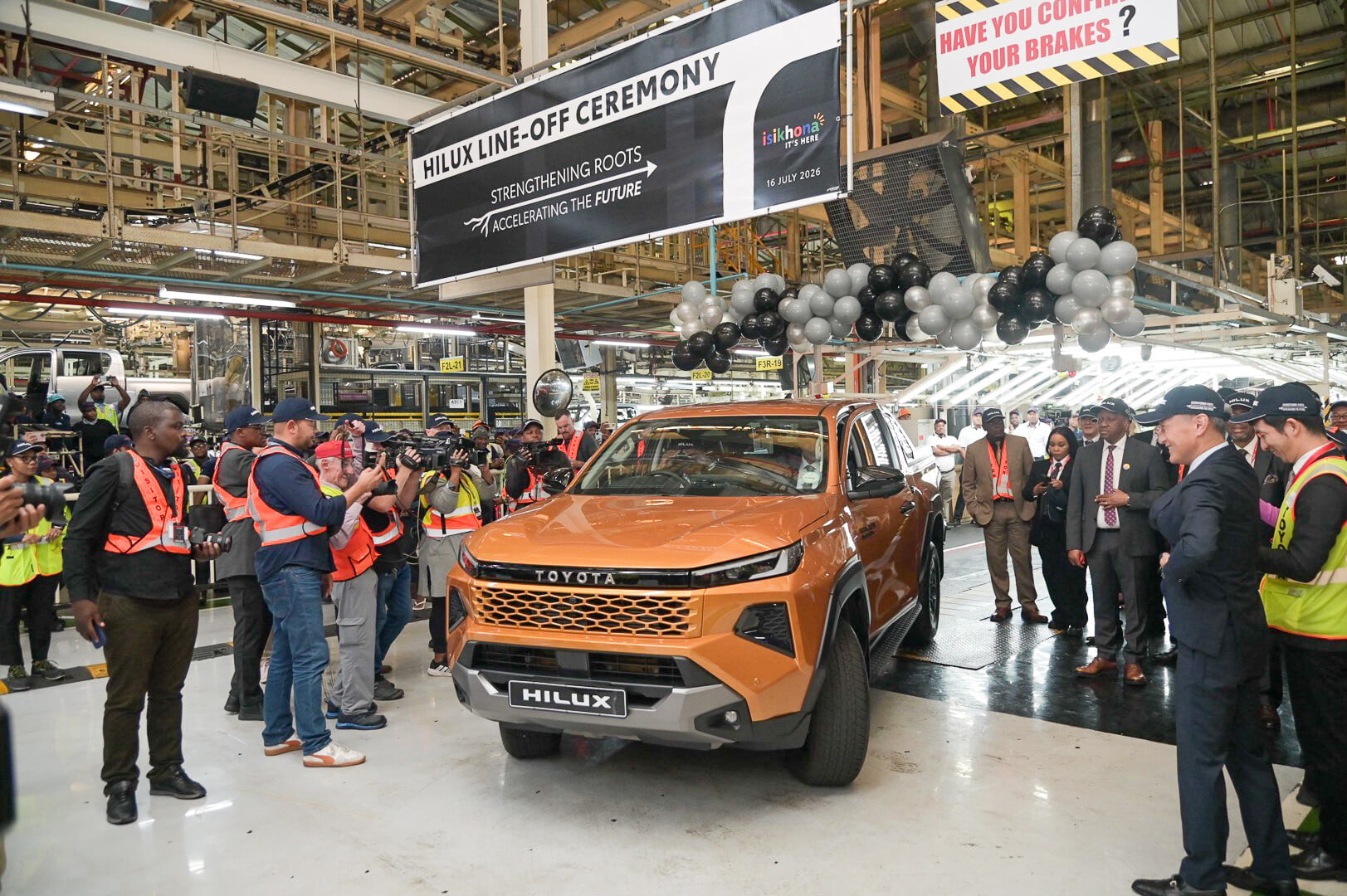
Toyota South Africa Motors has marked the commencement of production of the ninth-generation Hilux at its Prospecton plant in Durban, an event that signals a significant development in the country’s industrial landscape.
The ceremonial line-off was attended by Trade, Industry and Competition Minister Parks Tau, Japanese Ambassador Fumio Shimizu, and senior executives from Toyota Motor Corporation with President Cyril Ramaphosa missing out due to an issue with his aircraft.
The new Hilux programme represents a R10,4-billion investment, the largest single product commitment in the history of Toyota South Africa Motors. This capital injection is aimed at reinforcing the country’s position as a competitive manufacturing hub within Toyota’s global production network. The investment is structured to strengthen local supply chains and deepen the company’s long-term presence in the region.
All the Hilux your could ever want can be found right here
The Hilux has been produced at the Prospecton facility for 56 years, with more than 2,9-million units manufactured over that period. These vehicles have been exported to 74 markets across Africa and Europe.
The model currently supports a broad industrial ecosystem that includes 101 Tier One suppliers, with an annual procurement spend exceeding R15-billion. The production line directly employs more than 4 300 workers, while nearly 27 000 jobs are sustained across the broader supplier network.
Andrew Kirby, President and Chief Executive Officer of Toyota South Africa Motors, said the new Hilux represents more than a model change. He noted each new generation offers an opportunity to upgrade technology, develop the supplier base, increase local content, and improve operational efficiency.
He added the scale of the investment reflects the company’s confidence in the country’s manufacturing capabilities and its people. Kirby also emphasised the impact of such investment extends beyond vehicle assembly, contributing to supplier growth, skills development, and the broader industrial economy.
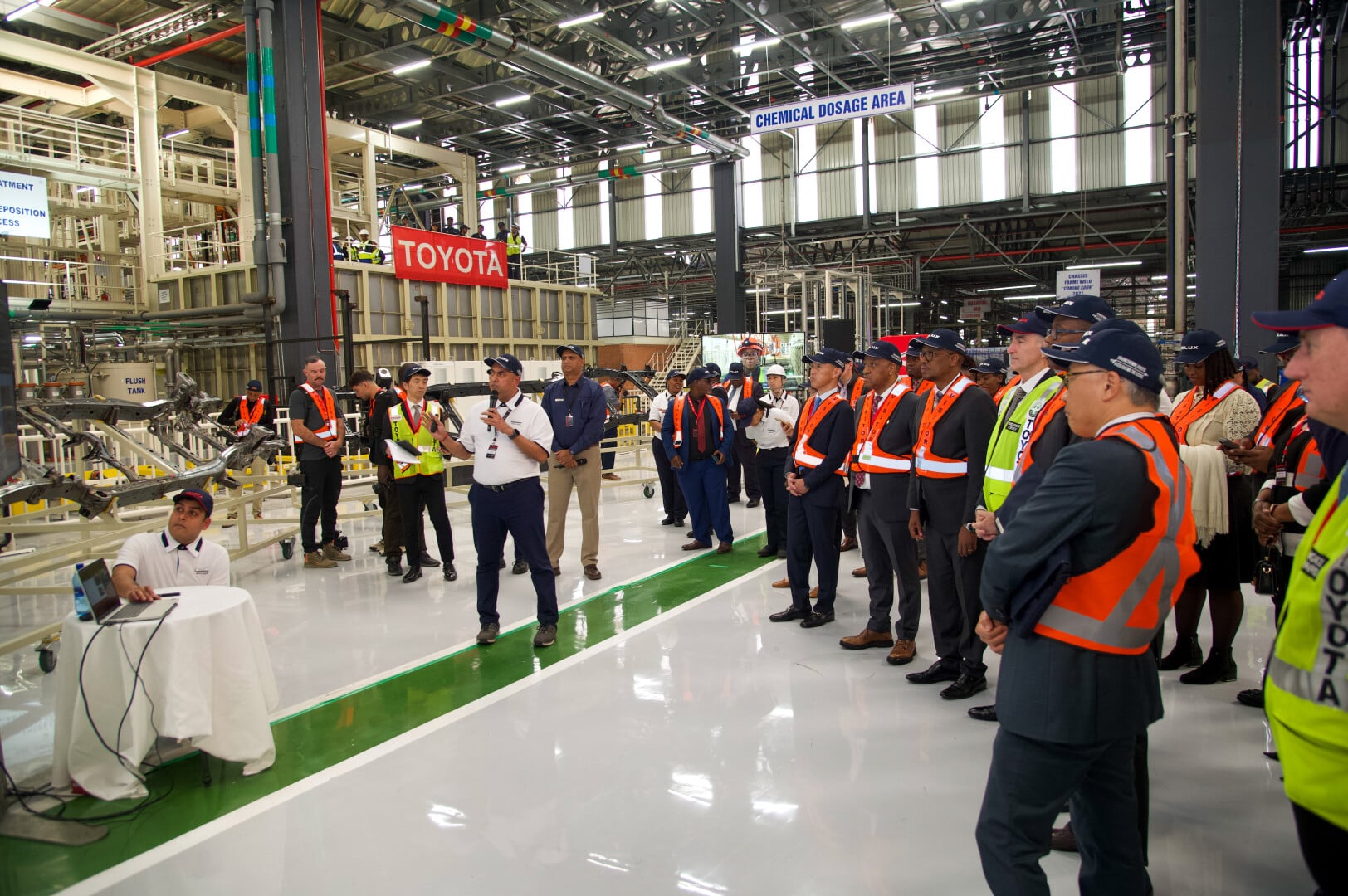
The investment programme includes three major infrastructure projects: a new 29 300-square-metre logistics centre, a chassis frame coating facility and a chassis frame welding facility, with the latter two scheduled for completion by June 2027.
Of the total investment, R3,2-billion has been allocated to local supplier development to support domestic value chains and localisation targets. An additional R7,2-billion has been directed towards production preparation, including advanced manufacturing technologies, equipment, and supplier tooling. Toyota’s supplier partners have also committed R2-billion in their own facility upgrades and capability enhancements.
Can I afford it – find out with this handy Finance Calculator
Shinichiro Otsuka, Chief Operating Officer of the Toyota Tsusho Africa Division and Regional Chief Executive Officer of Toyota Africa, commended the local operation for its contribution to the global manufacturing network. He reiterated the parent company’s confidence in South Africa and its workforce, and noted that ongoing investment in technology, skills and localisation affirms the country’s strategic importance to Toyota’s worldwide production strategy.
The Prospecton plant is the oldest Toyota factory outside Japan and remains one of South Africa’s flagship manufacturing operations. In addition to the Hilux, the facility produces the Corolla Cross, Fortuner, and Hiace. Toyota has been active in the country since 1961 and has held the position of leading automotive brand for 46 consecutive years.
In the address given on his behalf, President Ramaphosa highlighted the importance of sustained investment in manufacturing and the value of partnerships between government and industry.
He said the R10,4-billion commitment demonstrates the type of investment the country seeks to attract and noted that the new facilities would further strengthen Prospecton’s standing within Toyota’s global network. He added the true value of the investment lies not in physical infrastructure alone, but in the opportunities it creates for employment and economic participation.
The ninth-generation Hilux programme has also driven skills development, with a number of employees and specialists participating in global training programmes, international exchanges, and leadership initiatives. Through the Toyota Manufacturing Academy and the Future of Manufacturing initiative, the company continues to invest in developing the next generation of local manufacturing talent.
You are just one click away from finding the very best finance deal for your new car
Toyota employs more than 8 500 people across its South African operations and supports additional jobs through its supplier, logistics and dealer networks. The company has stated its commitment to inclusive economic growth and alignment with national development priorities.
The new Hilux introduces updates in design, safety, connectivity, and driving performance, while retaining the durability and reliability associated with the model. It is being introduced progressively in local and export markets through a phased rollout to maintain supply continuity during the production transition.
Concluding the event, Kirby spoke of the responsibility shared by industry and government to secure the future competitiveness of the automotive sector. He noted that the previous generation had built one of Africa’s most successful manufacturing stories, and that the task now is to ensure that the next generation inherits an even stronger foundation. He described the latest investment as a step towards that objective.
Colin Windell for Colin-on-Cars in association with
proudly ALL THINGS MOTORING

