

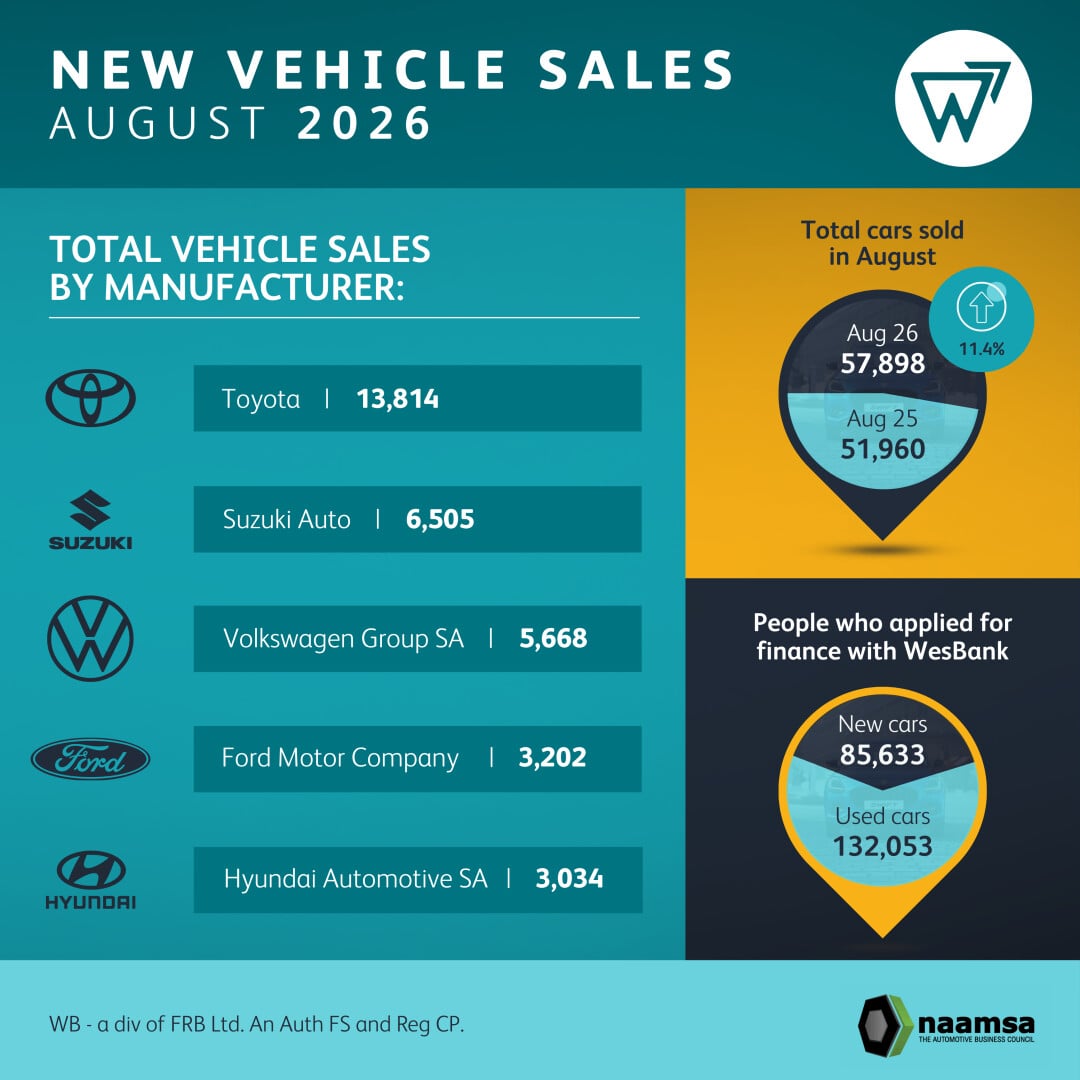
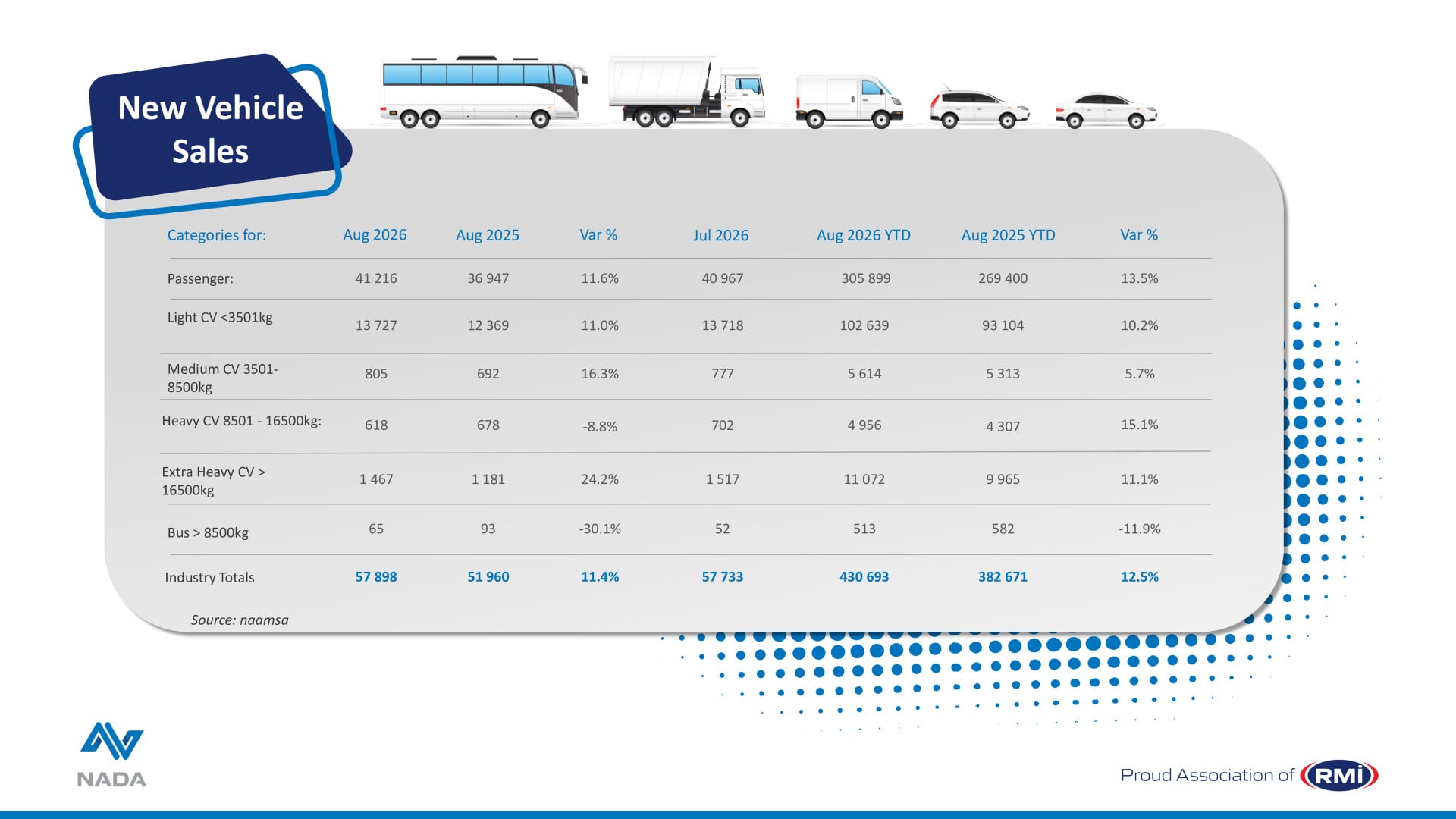
South Africa’s new vehicle market recorded its sixth consecutive month of growth in August, with aggregate sales reaching 57 898 units, an increase of 11,4 % compared with the same month last year. The performance extends a recovery trend that has gathered pace through 2026, although vehicle exports continued to decline, falling by 11,9 % to 35 091 units.
The passenger car segment remained the primary driver of growth, with 41 216 new cars sold during the month, reflecting an 11,6 % increase from the 36 947 units moved in August 2025. Light commercial vehicle sales, including bakkies and minibuses, rose by 11,0 % to 13 727 units, while medium commercial vehicle sales increased by 16,3 % to 805 units. Heavy trucks and buses recorded a more modest gain of 10,1 %, reaching 2 150 units.
Dealer networks continued to serve as the dominant distribution channel, accounting for an estimated 81,8 % of total industry sales. The vehicle rental industry contributed 13,4 % of aggregate sales, with rental agencies accounting for 17,2 % of new passenger car sales during the month. Government purchases and corporate fleets each represented 2,4 % of the total market.
Can I afford it – find out with this handy Finance Calculator
Brandon Cohen, National Chairperson of the National Automobile Dealers’ Association, said consumer appetite for new vehicles had remained strong despite continued pressure on household budgets and rising operating costs.
“The rental industry made an important contribution, but dealers also enjoyed a positive month,” Cohen says. “The performance shows that consistent marketing, knowledgeable sales teams and good customer service continue to pay off in a highly competitive market.”
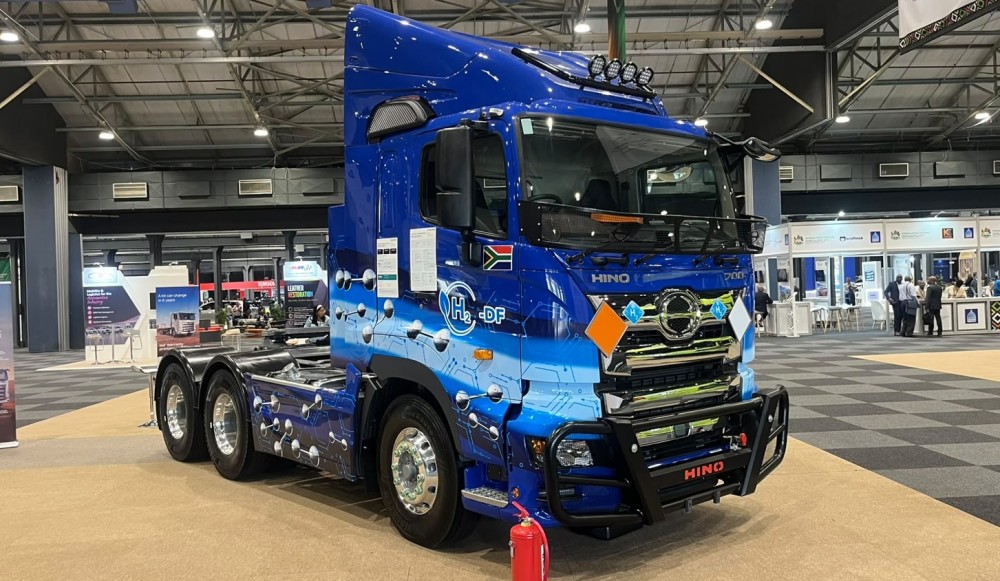
The commercial vehicle segment provided encouraging signals about economic activity, with extra-heavy commercial vehicle sales rising by 24,2 %.
Martin van den Berg, NADA Regional Executive, said the growth in the extra-heavy segment was particularly interesting given rising fuel costs and reduced activity in commodities such as iron ore.
“It may point to increased activity in other areas of the economy, including construction, with dealers reporting stronger enquiries for vehicles such as tippers,” he says. He added newer market participants including Foton and Shacman were increasing competition and choice in the commercial vehicle sector.
Looking for a safe car for a student then click here
The macroeconomic environment provided some support for vehicle demand during August, with headline consumer inflation moderating to 4,3 % in July from 5,0 % in June, supported by lower transport inflation and slower food price increases. The South African Reserve Bank maintained the repo rate at 7,00 %, with the prime lending rate at 10,50 %, offering greater stability in the affordability environment facing households and prospective buyers.
Fuel price movements presented a mixed picture. Private motorists benefited from petrol price reductions of 52 cents a litre from August 5, following declines of between R1,96 and R2,01 a litre in July.
Commercial operators, however, faced a more difficult cost environment, with wholesale diesel prices increasing by between R1,23 and R1,38 a litre during August. From September 2, both grades of petrol are set to rise by R1,34 a litre, while wholesale diesel will increase by between R2,93 and R3,15 a litre, adding further pressure on transport and logistics operators.
Adoption of new energy vehicles continued to accelerate, with 16 289 NEVs sold during the first seven months of 2026, an increase of 88,0 % compared with the same period last year and already equivalent to 97,5 % of total NEV sales recorded for the whole of 2025. The year-to-date mix comprises 8 078 hybrids, 5 851 plug-in hybrids and 2 360 battery electric vehicles. Plug-in vehicles accounted for 54,4 % of NEV sales during July, overtaking traditional hybrids and signalling a deepening of the country’s electrification transition.
Thanda Sithole, Senior Economist at FNB and WesBank, pointed out buyers were increasingly looking beyond the purchase price or monthly instalment when making vehicle decisions.
“The purchase price or monthly repayment is only one part of the equation. Fuel consumption, maintenance, insurance and expected vehicle usage all contribute to what a vehicle ultimately costs over the life of the agreement.”
Starting or running a small business and in need of a bakkie – click here
Dealers reported customers were asking more detailed questions about fuel consumption, finance, insurance, servicing and warranties, indicating a more mature buying process.
The decline in vehicle exports, however, highlights the need to strengthen industrial competitiveness and translate improving domestic demand into local production, localisation, investment and employment. For naamsa, the key policy imperative remains supporting an adaptable, multi-pathway transition while converting growing domestic NEV demand into local manufacturing, component production, skills and employment.
Top 10 Best?Selling Passenger Vehicles — August 2026
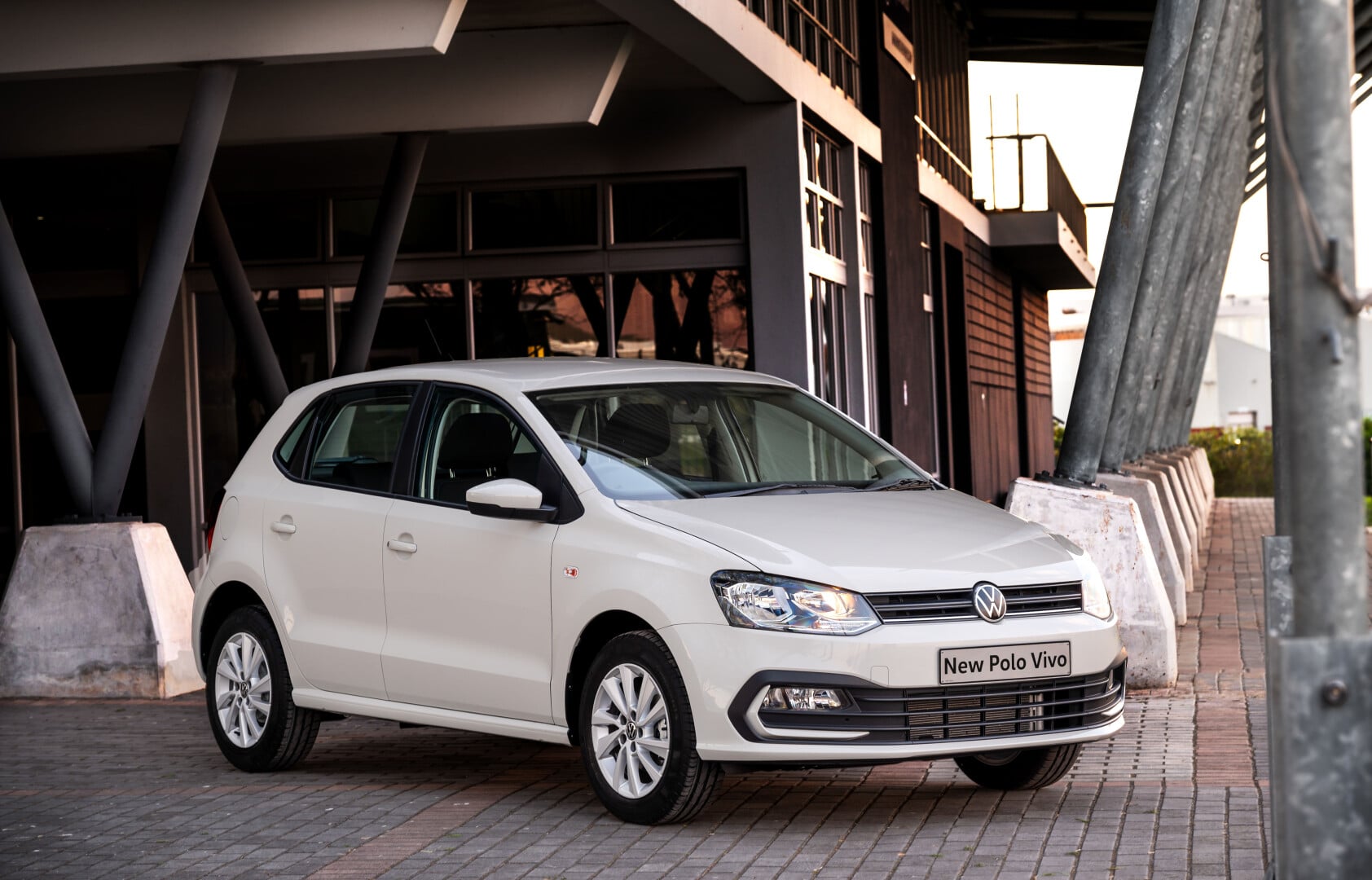
- Volkswagen Polo Vivo — 2,351 units
- Chery Tiggo 4 Pro — 2,297 units
- Suzuki Swift — 2,152 units
- Toyota Corolla Cross — 1,489 units
- Hyundai Grand i10 — 1,432 units
- Toyota Starlet — 1,359 units
- Suzuki Ertiga — 1,317 units
- Haval Jolion — 1,261 units
- Toyota Starlet Cross — 1,015 units
- Suzuki Fronx — 970 units
Top 10 Best?Selling Light Commercial Vehicles — August 2026
- Toyota Hilux — 3,881 units
- Ford Ranger — 2,373 units
- Isuzu D?Max — 2,005 units
- Mahindra Scorpio Pik?Up (exact units not listed, but ranked behind D?Max)
- Toyota Land Cruiser Pick?Up (units not listed, but in top LCV group)
Overall Top 10 (combined market):
South Africa’s market is dominated by bakkies, so the Hilux and Ranger are the country’s top sellers overall. Passenger cars fill the rest of the high?volume positions.
Overall Top Sellers (combined, by volume):
- Toyota Hilux — 3,881
- Ford Ranger — 2,373
- Volkswagen Polo Vivo — 2,351
- Chery Tiggo 4 Pro — 2,297
- Suzuki Swift — 2,152
- Isuzu D?Max — 2,005
- Toyota Corolla Cross — 1,489
- Hyundai Grand i10 — 1,432
- Toyota Starlet — 1,359
- Suzuki Ertiga — 1,317
Colin Windell for Colin-on-Cars in association with
proudly ALL THINGS MOTORING

