


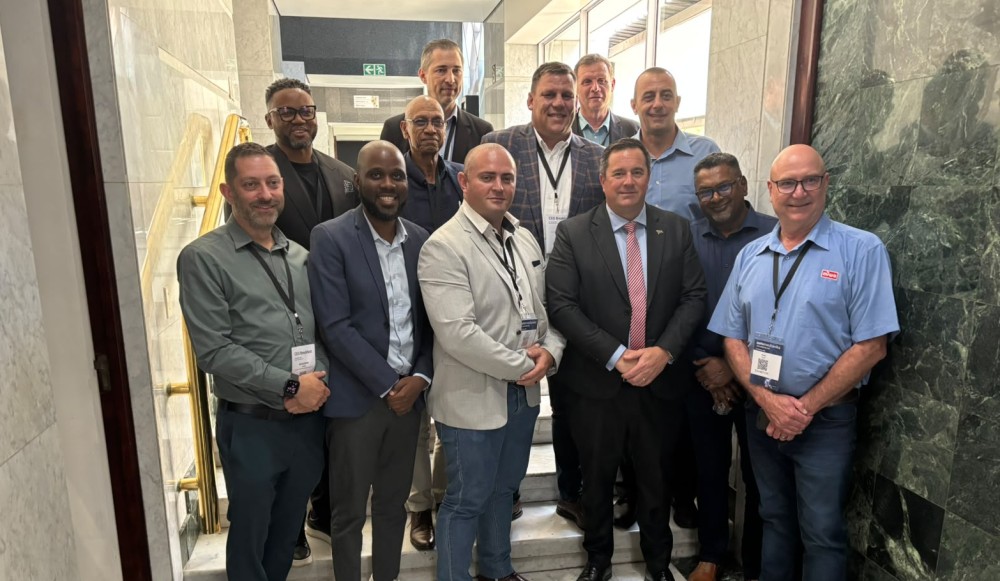
South Africa's automotive industry does not have a knowledge problem. It has a silence problem, and that silence is costing lives. That was the blunt message from Bobby Ramagwede, CEO of the Automobile Association, as the keynote speaker at the CEO breakfast marking the opening of Automechanika at Gallagher Estate.
In a speech that pulled no punches, he honed in on the twin crises of dangerous vehicle imports and a transport system that is failing the poorest.

Good insurance is vital – click here to find out more
Ramagwede opened by challenging the room to confront three uncomfortable truths, warning that nobody is coming to save the industry. The first is the wave of Chinese vehicle imports now accounting for more than 19% of all new vehicle sales in the country. While he was careful not to condemn every Chinese car, he warned South African consumers are being treated as guinea pigs for products that have not earned the right to be trusted with human lives.
The numbers he presented are damning. Consumer journalist Wendy Knowler's investigation into the National Consumer Commission's recall registers found that in 2025 the NCC processed 57 official safety recalls in South Africa, while Australia, a market twice the size, issued 135.
Yet, across a brand collective capturing nearly one-fifth of the national new vehicle market, almost none appeared on that register. The NCC confirmed Chery, the dominant force in the import wave, has been running what can only be described as silent recalls.
“On the Tiggo 8 Pro Max, a critical brake pipe campaign affected nearly 3 500 vehicles, more than 30% of every unit sold locally,” he said. “A brake clip can fail, allowing the brake line to shift against the turbo's scorching exhaust housing, creating a potential catastrophic brake loss and fire.
“Chery quietly sent an internal circular to dealers telling them to treat it as a priority, but never issued an open public safety recall. More than 2 100 of those vehicles remained on South African roads, carrying families at 120 km/h, with owners completely unaware.”
Ramagwede also blew the whistle on Jetour, another Chery Group brand, which ‘magically’ increased the payload rating on its T1 and T2 models from 300 kilograms to 475 kilograms, a 58% quantum leap on paper, without upgrading a single bolt, spring or mechanical component.
“When the AA insisted on an independent weighbridge test alongside the NRCS, the vehicle failed right before their eyes, yet those vehicles were already being advertised and sold.”

Your dream car – make it happen with the best finance deal
He contrasted this with Malaysia, where the road transport department immediately suspended type approval for pre-facelift petrol Omoda 5s across 8 800 vehicles after an entire rear axle detached from the chassis of one vehicle in Johor Bahru.
“In South Africa, the response was deafening silence.”
Ramagwede warned established Japanese and European automakers spent over a century refining manufacturing tolerances and stress testing, with catastrophic defect rates sitting at roughly one in 10 000, while certain new import stables are approaching alarming rates in local workshops and roadside recovery logs.
“These are not toasters,” he said. “They are two-ton steel projectiles carrying our children.”
The economic warning extends beyond safety. Ramagwede pointed to Thailand, which opened its borders to massive Chinese EV import subsidies without safeguarding its local manufacturing ecosystem. In four short years Chinese brands seized 85% of their EV market, Suzuki and Subaru closed their plants, and dozens of tier two and tier three domestic component suppliers went bankrupt.
Skilled artisans who spent decades crafting exhaust systems and chassis components now earn $11 a day packing shelves at supermarkets. Thailand's chief economic planner publicly admitted they did not think of the full picture.
“South Africa,” Ramagwede warned, “is no exception unless it demands strict local homologation, real weighbridge verifications, transparent recall compliance and reciprocal industrial value.”
The second crisis is mobility in a world strangled by fuel hyperinflation. While Elon Musk captivates global headlines with flying autonomous cars, Ramagwede said the future of mobility in South Africa depends on whether a mother in Orange Farm or Khayelitsha can afford the basic human right to move.
Official policy says household transport spending should never exceed 10% of total income, yet Stats SA puts the national average at 16%. On the national minimum wage of just over R5 000 a month, the average worker spends R1 520 on taxi fares alone, with transport and basic electricity eating up over 64% of take-home pay. Workers are left with less than R1 800 to feed a family of four for 30 days.

Starting or expanding your business and in need of a bakkie – click here
“More than 25% of South African boys under the age of five suffer from stunting due to chronic malnutrition because their mothers are forced to choose between the taxi fare to keep their jobs and buying eggs and milk for their children. Our transport system is actively starving our children,” he said.
The cause, he argued, is spatial apartheid and total policy failure. Low-income workers pay a double-fare penalty every morning and evening, R72 a day and R1 580 a month in cash. The minibus taxi industry carries more than 80% of all public transport commuters, yet receives zero operational subsidy, while bus operators get lavish subsidies.
“Every hike in crude prices, the General Fuel Levy and the Road Accident Fund levy is passed directly onto the poorest commuters. Taxi operators are trapped between bankruptcy and abandonment, unable to raise fares without collapsing ridership or keep them flat without running at an operational loss.
“The crisis extends to aviation, where aircraft sit parked because South Africans cannot afford domestic airfares and to the roads at dawn, where an unprecedented army of commuter cyclists pedal 20 to 30 kilometres along unlit highways without cycle paths because they cannot afford the taxi fare.”
Meanwhile, Ramagwede noted between 2019 and 2023 the Gauteng Department of Roads and Transport handed the Bombela Concession Company R5,1-billion in contractual patronage guarantees for the Gautrain, while passenger trips collapsed from nearly 14-million to under 8-million.
Billions in public money are insuring the commercial profits of an empty luxury train service for a wealthy elite while Metrorail tracks sit stripped and gutted. He poured scorn on the Gautrain Management Agency's plans to launch an e-hailing service called Gau Express, calling it vanity masquerading as public policy.
“We must stop funding vanity projects and start funding purpose and greater mobility equality,” he said.
The third truth is policy paralysis and the slow collapse of the domestic automotive industry.
“South Africa has arrived at a fork in the road,” said Ramagwede. “Either it remains an industrial manufacturing powerhouse that builds, welds and exports motor vehicles, or it abandons that legacy and becomes a pure import-and-retail trading desk.
“Right now government is attempting to do both under a contradictory, chaotic hodgepodge of policy, trying to mix oil and water without a powerful emulsifier. In an industrial economy that emulsifier must be a competent, decisive, visionary state coordinating trade policy, energy security, rail logistics, port operations and localised manufacturing incentives with ruthless precision. We do not have said emulsifier,” he said.
Instead there is policy paralysis. Government talks endlessly about new energy vehicles while localised incentives remain sluggish and opaque and foreign competitors dump subsidised imports into dealerships.
Transnet bottles up ports, forcing OEMs to incur crippling demurrage costs while finished vehicles sit stranded offshore and export containers rot on sidings.

Ramagwede used the dinner party trick of yanking a tablecloth from under loaded plates to illustrate the point. If you want the plates to stay safely on the table, you must grab that cloth and yank it with blinding speed and absolute conviction.
“What is our government doing? They are not yanking the cloth. They are slowly, timidly, hesitantly dragging the tablecloth inch by inch, while the plates wobble, the wine glasses tilt and the cutlery slides inexorably toward the edge.
When that crockery hits the floor and shatters,” he warned, “you cannot simply glue it together again. Once the toolmakers pack up their dies, once the foundries shut down their blast furnaces, once the tier three engineers leave our shores, no one comes back.”
Why is this being allowed?
“Because the private sector has gone quiet,” Ramagwede told the room. “The captains of industry are terrified that if they speak plainly, criticise the Department of Trade, Industry and Competition, challenge the Department of Transport or question the fuel levies, they will lose their seat at the negotiating table, face an audit, ostracism or be passed over for government fleet procurement.
“You are afraid to bite the hand that feeds you crumbs, while that same hand starves your entire ecosystem,” he said. “Strip away the political noise. South Africa is not an ideological experiment; run it like a business.
“If you sat on the board of a major enterprise and saw logistics failing, fuel costs bankrupting your consumers, imported products destroying your core manufacturing margins and capital draining into vanity projects, would you smile, nod and compliment management on their slides?
“Not a chance. You would intervene, right-size the operation, overhaul the strategy, fire incompetent management and demand accountability. You are the board of directors of the South African automotive industry. It is time you start acting like it.”
Ramagwede's closing charge was a call to speak truth to power. Silence is not diplomacy. Silence is complicity. To the National Consumer Commission and the NRCS, he demanded an end to turning a blind eye, mandatory public safety recalls for every defective imported vehicle, an end to accepting foreign laboratory paperwork on blind faith and local weighbridge and crash-testing for every imported model before citizens pay with their lives.
To the Department of Transport and National Treasury, he called for scrapping vanity spending, stopping the billions in patronage guarantees for empty luxury trains and reallocating those funds to mass commuter rail, bus rapid transport networks and subsidising the minibus taxi industry that keeps South Africa working.
He demanded an immediate independent audit of the General Fuel Levy and the Road Accident Fund to strip away the artificial tax bloat crushing transport operators and working families and a review of the basic fuel price.
To every CEO, dealer principal, component manufacturer and aftermarket leader in the room, he said the industry has the economic leverage, the technical knowledge and the institutional voice to take ownership.
“Yes, speaking out will ruffle feathers and invite flak from bureaucrats who would rather maintain the illusion of control, but I would rather take censure for speaking the truth for South African jobs and South African lives than die a slow, cowardly corporate death on an abandoned factory floor.
“Stand up for your component suppliers. Stand up for your assembly workers. Stand up for the mother who has to walk through the dark because she cannot afford the taxi fare.
“Stand up for that five-year-old who suffers the consequences. Stand up for the dignity of South African mobility. Let us lift our heads out of the sand and speak truth to power.
If we unite, we can rebuild this country's automotive industry into one we can be proud of, one that is more vibrant and useful. We have no other choice. As my father often says, and it is a hard truth: no one will save us. We must save ourselves.”
Colin Windell for Colin-on-Cars in association with
Proudly ALL THINGS MOTORING

