


While South African consumers continued to feel the pinch of a high-cost economy last year, the average price tag on a new passenger car settled at approximately R370 000, according to the latest aggregated data from naamsa | The Automotive Business Council and Lightstone.
However, this national average masks a widening chasm in the auto market, where budget-conscious commuters battle rising specification costs for commercial fleets, and where a record-breaking sales year was driven not by luxury spending, but by a hunt for value.
As the final aggregate figures for 2025 are tallied, industry analysts point to a year of extremes. At the entry-level, the average transaction for a new passenger car hovered around the R370 000 mark.

Looking for a safe car for a student then click here
Yet, for businesses and entrepreneurs reliant on light commercial vehicles (LCVs)—the ubiquitous bakkies and minibuses that serve as the backbone of small enterprise—the average price rose significantly to roughly R480 000. This increase is attributed to a sustained appetite for higher-spec double cabs, which has steadily pushed the average transaction price upward.
The commercial spectrum reveals even steeper financial requirements. Medium commercial vehicles averaged R750 000, while heavy-duty trucks commanded an average of R1,2-million. At the top of the scale, new buses entering the fleet averaged closer to R1,5-million .
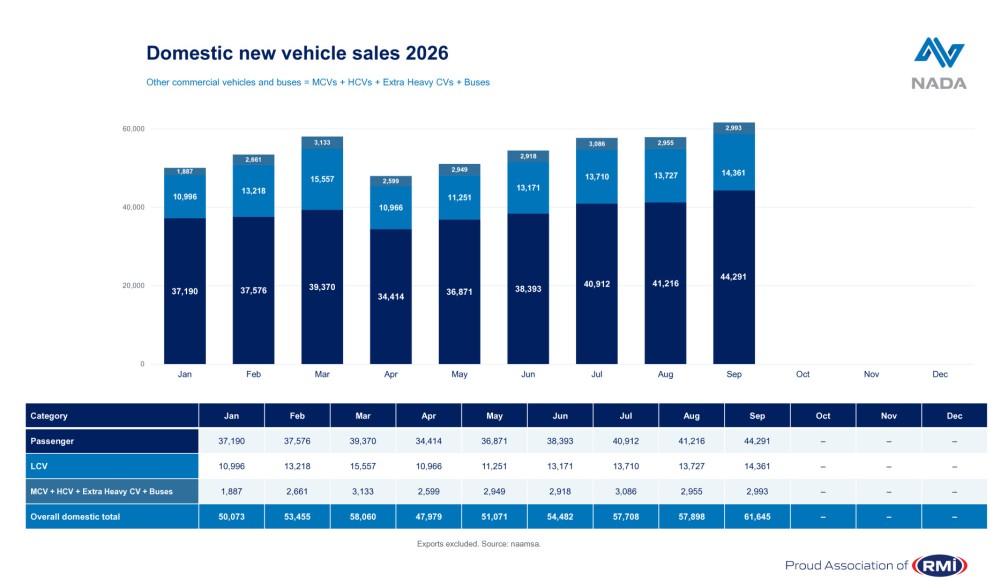
Despite these pricing pressures, 2025 proved to be a landmark year for the local automotive industry. Data verified by naamsa shows total new vehicle sales surged to 596 818 units. This performance not only marks a significant recovery from the pandemic years but represents the highest level of sales recorded in the past decade .
The driver of this growth was surprising: record-low vehicle inflation. While consumers grappled with the cost of living, the cost of the vehicles themselves rose by only 1,5% in 2025. This was the lowest rate of vehicle price inflation since 2008, largely driven by aggressive competition and an influx of affordable imports from markets like China and India .

Great insurance is a safety net you really need – click here to find out more
This intense competition has structurally altered the market landscape. TransUnion’s Q4 2025 Mobility Insights Report notes Chinese brands, once a niche sighting, have cemented their presence, growing at nearly nine times the pace of the overall market to capture more than 17% of passenger vehicle sales . This shift has forced established players to reconsider pricing strategies, effectively holding down the average cost of entry-level mobility.
The Light Commercial Vehicle segment remains the emotional and commercial heart of the industry, accounting for roughly a quarter of the 2025 volume. While the average sat at R480 000, the bakkie market is increasingly polarised. On one end, budget-focused single cabs remain available below the R200 000 mark, but on the other, luxury double cabs are pushing the average higher as they double as family transport .
Furthermore, Lightstone data indicates a fundamental shift in what South Africans want to drive. Crossovers and Sport Utility Vehicles (SUVs) have officially overtaken traditional hatchbacks as the country's preferred body shape in the used vehicle market—a trend that has been echoed in new sales for several years.
Gauteng buyers led this switch in 2023, followed by KwaZulu-Natal in 2025, with the Western Cape now on the brink of a similar transition . This demand for SUVs is helping to support the average price floor in the passenger segment.
While the average prices appear stable, the method of payment is evolving. The total market value of vehicle sales is heavily influenced by financing costs. Although the South African Reserve Bank began a cutting cycle in late 2024, bringing some relief, the prime lending rate remains elevated compared to historic lows. Data from TransUnion shows a revival in credit extension, but buyers remain highly sensitive to monthly repayments .

Can I afford it – find out with this handy Finance Calculator
There is a clear flight to value. Suzuki Auto, for instance, recorded its best-ever sales month in January 2025, moving 6 399 units. The bulk of these sales came from the new Swift, which became the country's overall best-selling model that month, largely on the back of its affordability and fuel efficiency .
This suggests that while the average price is R370 000, a significant volume of sales is happening well below that line, balanced out by premium SUV and Double Cab sales pulling the average up.
Looking at the broader five-year trajectory from 2019 to 2025, a clear pattern emerges of resilience at the bottom and volatility at the top.
For the past half-decade, passenger cars have consistently provided volume, though the mix has changed as sedans fade and crossovers rise. LCV volumes have shown steady growth, reflecting the rise of the ‘lifestyle bakkie’ and entrepreneurial activity.
In contrast, the heavy commercial segments (HCV, XHCV, and Buses) remain a story of high risk and high reward. These categories are disproportionately reliant on import supply chains and are acutely sensitive to the value of the Rand. A sudden depreciation of the local currency immediately inflates the replacement cost of fleet vehicles, often leading to deferred investment and a drop in volume.
The outlook for 2026, as forecast by naamsa, suggests a continued growth trajectory of roughly 10%, contingent on interest rate relief and stable inflation . However, industry stakeholders are wary of external shocks, including the potential exclusion from the African Growth and Opportunity Act (Agoa) and the looming costs associated with the transition to New Energy Vehicles (NEVs), which remain a marginal, though growing, segment of the market .
For now, the South African new vehicle market finds itself in a delicate balance: high volumes driven by low margins and fierce competition, with the average consumer paying R370 000 for a car, but only because the alternative—not buying one—is simply not an option in a country with limited public transport.

Starting or running a small business and in need of a bakkie – click here
Here’s the combined view: the dual?axis chart now shows both the average prices and sales volumes per NAAMSA category in South Africa for 2025. Passenger cars stand out with the lowest average price (~R370k) but the highest sales volume (~320k units), while buses and extra heavy commercial vehicles have the highest prices (R1.5m+) but very low volumes.
???? Combined Dataset (Prices vs. Volumes)
Category | Average Price (ZAR) | Sales Volume (Units) | Key Insight |
Passenger Cars | ~R370,000 | ~320,000 | Affordable, mass?market dominance |
Light Commercial Vehicles | ~R480,000 | ~150,000 | Strong demand for bakkies/minibuses |
Medium Commercial Vehicles | ~R750,000 | ~8,000 | Niche logistics use |
Heavy Commercial Vehicles | ~R1,200,000 | ~6,000 | Capital?intensive fleet purchases |
Extra Heavy Commercial Vehicles | ~R1,600,000 | ~12,000 | Long?haul trucking, high cost |
Buses | ~R1,500,000 | ~2,000 | Specialized, low?volume market |
Colin Windell for Colin-on-Cars in association with
proudly CHANGECARS

